
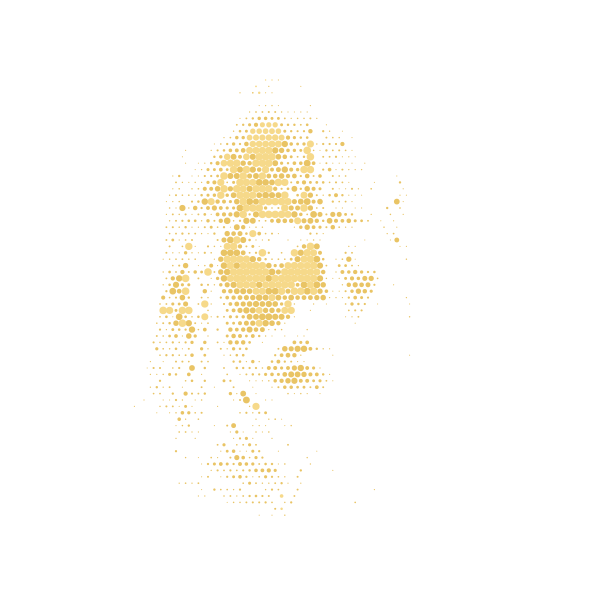
Nizam al-Mulk
Founder — Vizier
The statesman who built the network and wrote the Siyasatnama.
The Mind of an Empire
A thousand years ago, the mind of a civilization was lit here. Step across the threshold.
The Seljuk Beacon of Knowledge
The network of schools that built an empire's mind in the 11th century — the patronage of Malik-Shah, the order of Nizam al-Mulk, the learning of al-Ghazali.
Scroll to exploreThe Mind of an Empire
The Nizamiye madrasas were the first systematic, state-funded network of higher learning, founded by the Great Seljuk vizier Nizam al-Mulk. Its flagship, opened in Baghdad in 1067, became the foremost institution of its age — with salaried teachers, scholarship students and a rich library.
Stretching from Nishapur to Isfahan, from Basra to Baghdad, this network united jurisprudence, theology, logic and the language sciences under a single curriculum. Its aim was not knowledge alone, but to build the mind and order of a civilization.
The vizier's rivals complained to the sultan that Nizam al-Mulk spent three hundred thousand dinars a year on madrasas and ribats — six hundred thousand by one account. The library building burned down in the fire of 1116; the students saved the books at great cost to themselves. Caliph al-Nasir li-Din Allah rebuilt it in 1193 and endowed thousands of volumes from his own palace.
Academic titles existed 800 years ago too: the müderris owned the lecture, the muid was the assistant who repeated it for the students. The name müderris took such root that at the Darülfünun it became the word for professor; the word for associate professor was müderris muavini. Both titles survived until the 1933 university reform. The icazet was a certificate of competence granted in the teacher's own name — it carried not the school's name, but the teacher's, and the books he had taught.
Founder — Vizier
The statesman who built the network and wrote the Siyasatnama.
Patron — Sultan
The ruler who championed learning from the Seljuk throne (1072–1092).

Professor (Müderris) — Scholar
At the head of the Baghdad Nizamiye, the 'Proof of Islam'.
These portraits are not historical records. No contemporary likeness of al-Ghazali, Nizam al-Mulk or Malik-Shah has survived; the images here are representational reconstructions generated with artificial intelligence.
Founder — Vizier
The Hand That Built Order
Abu Ali Hasan al-Tusi — remembered as Nizam al-Mulk, 'the order of the realm.' He served as vizier to Alp Arslan and Malik-Shah for some thirty years, turning the Great Seljuk state into an empire of order and institutions.
He wrote the Siyasatnama on the art of government and founded the network of madrasas that bears his name: from Baghdad to Nishapur, the most organized web of learning of its age, with salaried teachers and scholarship students.
Tap a city
«A realm may endure with unbelief, but not with injustice.» — the spirit of the Siyasatnama
Abu Ali Hasan al-Tusi was born on 10 April 1018 in the village of Radkan near Tus, in Khorasan. His father was a tax official for the Ghaznavids, so the boy grew up among ledgers from the first day. He lost his mother in childhood. After memorising the Qur'an he took to the road for learning and studied under four different teachers in Aleppo, Isfahan, Nishapur and Baghdad. The man who would one day build a network of learning first walked from city to city in its absence.
On 7 December 1063 he became Alp Arslan's vizier and held the office until his assassination. One of his first acts was to end his predecessor's discriminatory policy against Ash'ari scholars; al-Qushayri and al-Juwayni, who had left the country, could return home. Al-Qushayri had been his own teacher years earlier in Nishapur. The madrasas were the most visible face of this order: Baghdad's foundations were laid in November 1065 and its doors opened on 22 September 1067; Nishapur, Isfahan, Balkh, Mosul, Basra, Herat, Merv and Amul followed.
For thirty years he rode with Alp Arslan and Malikshah on campaign. The TDV records that he joined every one of Alp Arslan's campaigns except Manzikert. The most famous battle in Seljuk history is the single campaign the vizier missed.
His son Mu'ayyid al-Mulk had appointed a scholar to the professorship of the Baghdad Nizamiye. His father refused to recognise the decision and installed his own choice instead. In the madrasa's early years Nizam al-Mulk chose the professors himself.
Hasan-i Sabbah settled at Alamut on 4 September 1090; Nizam al-Mulk was killed two years and one month later. The name given to the movement, hashishi, passed into Western languages as "assassin".
Holders of iqta should be rotated every year or two — so that the province is developed and the people are treated well.
Source: TDV Encyclopaedia of Islam — NİZÂMÜLMÜLK, NİZÂMİYE MEDRESESİ, SİYÂSETNÂME
Patron — Sultan
The Throne That Sheltered Knowledge
Malik-Shah, son of Alp Arslan, brought the Great Seljuk Empire to its widest borders (1072–1092); under Nizam al-Mulk's order the realm knew stability and prosperity. Yet his true legacy lies not in the sword but in patronage.
In 1079 he built an observatory at Isfahan and gathered the era's greatest mathematician-astronomers — among them Omar Khayyam — to reform the calendar. The result: the Jalali calendar, which measured the solar year with extraordinary precision.
Drag the slider: as the years pass, see how far each calendar 'drifts' from the true solar year. Malik-Shah's Jalali calendar barely moves — accurate enough to astonish even centuries later.
The Jalali calendar drifts by only one day in ~5000 years — more precise than the Gregorian.
Malikshah took the throne at seventeen. When his father Alp Arslan was fatally wounded on campaign, he made both his vizier and his commanders swear allegiance to his son; Malikshah took the throne on that oath on 24 November 1072. Twenty years later, when he died, his dominion stretched from Kashgar to the Bosphorus, from the Aral Sea to Yemen. The man who built it was only thirty-seven.
His real legacy accumulated elsewhere. In 1074 an observatory was founded at Isfahan, and a panel of five led by Omar Khayyam set out to measure the true length of the year. They first tried to repair the old calendars; finding it impossible, they began from nothing. Five years later, on Friday 15 March 1079, the Jalali calendar came into force — its new year tied not to a rule but to the sky, to the spring equinox — the moment when day and night stand equal. In those same years he moved the capital to Isfahan, had wells dug along the pilgrimage roads, and at the Armenian patriarch's request exempted churches from taxation.
He was a skilled rider and played chovgan, but his true passion was the hunt. From the horns and hooves of the animals he took, he had two landmark towers built: one on the Baghdad–Mecca road, the other in Transoxiana.
On 24 April 1087 he was received at the caliphal palace in a magnificent procession. The caliph gave him gifts and robes of honour, then girded him with two swords to signify that he was sovereign of both East and West.
His most powerful wife entered history as Terken Hatun — yet "Terken" was not a name but a title. Her true name is unknown. She was also called Jalaliyya Hatun, after her husband's epithet.
You are inventing a new religion and deceiving the ignorant. Persist in your error and I will raze your fortresses.
Source: TDV Encyclopaedia of Islam — MELİKŞAH, ÖMER HAYYÂM, CELÂLÎ TAKVİMİ
Interactive — Finding New Year by Shadow
What set the Jalali calendar apart was this: its new year was tied not to a rule but to a real observation. Khayyam and his panel spent five years doing exactly that. Now do it yourself — drag the slider, watch the shadow, and find the day when day and night are equal.
Look not for the day of the shortest shadow, but for the day when day and night are equal.
The panel measured the year at 365.2424 days. Today's figure is 365.2422. The error amounts to a single day in five thousand years.
Source: TDV Encyclopaedia of Islam — CELÂLÎ TAKVİMİ, ÖMER HAYYÂM
Proof of Islam
Imam of Reason and HeartTus, 1058 — Tus, 1111
Abu Hamid al-Ghazali took the chair of the Baghdad Nizamiye while still in his early thirties. At the summit of his age in law, theology and philosophy, he taught some three hundred students over four years.
In 1095 a profound spiritual crisis led him to leave the chair and withdraw into seclusion. After years on this journey he wrote the works that reconciled knowledge with practice, reason with heart — foremost the Ihya Ulum al-Din, which nourished Islamic thought for centuries.
Al-Ghazali was born in 1058 in Tus, Khorasan, into an artisan household. His father made his living selling what he spun with his own hands in a yarn shop; the name "Ghazzali" comes from that trade, from gazzal, "spinner". When the father understood that his life would not be long enough to educate his sons as he wished, he asked a friend of the Sufi path to look after them. The most influential thinker of his age came from neither court nor scholarly lineage.
The hardest lesson he learned came not in a classroom but on the road. Returning from his studies in Gurgan, bandits stripped his caravan of everything. Al-Ghazali went after them and asked at least for his lecture notes back; the chief mocked him and handed them over. He took this as a warning and within three years had memorised every one of them. He showed the same rigour before criticising philosophy: for two years he read the corpus of al-Farabi and Ibn Sina, worked on it for another year, and first wrote a book presenting the philosophers' views exactly as they held them — the critique came only afterwards.
While al-Ghazali still lived, legal opinions were issued in al-Andalus calling for the Ihya' 'ulum al-din to be burned; on that ruling the Almoravid ruler for a time forbade the work to be read in his lands.
The medieval Latin scholastics knew him as "Algazel". The Tahafut reached Europe by an indirect route: translated first from Hebrew into Latin, then printed twice in Venice.
You have buried me alive; could you not have waited for my death?
Then I was teaching the knowledge that wins rank; now I call to the knowledge that makes one abandon it.
Source: TDV Encyclopaedia of Islam — GAZZÂLÎ, İHYÂÜ ULÛMİ'd-DÎN, TEHÂFÜTÜ'l-FELÂSİFE
Life Journey
From the summit of learning to the dark of doubt, and thence to the light of the heart: al-Ghazali's life is the map of a search.
Born in Tus in Khurasan. He lost his father young; his first journey in knowledge began in his homeland.
At the Nishapur Nizamiye he became the student of al-Juwayni, the greatest theologian of the age, excelling in law, theology, logic and philosophy.
At just thirty-three Nizam al-Mulk appointed him professor of the Baghdad Nizamiye — the summit of fame: some three hundred students, among them renowned scholars of the day, the favor of sultans.
At his peak he suffered a profound spiritual crisis. He doubted all he knew, saw that truth is found not by imitation but by living it — and left the chair.
For years he traveled, purifying his heart through discipline and Sufism. On this journey he wrote his masterwork, the Ihya Ulum al-Din.
He returned home; in his last years of teaching, worship and writing he composed al-Munqidh min al-Dalal. He died in Tus in 1111.
Interactive Mechanism
Al-Ghazali held logic to be a balance (miʿyār) that weighs the truth of knowledge: 'One who does not know logic cannot be trusted in their knowledge.' Toggle the two propositions below and watch how the gates — logic's simplest building blocks — decide.
Inverts A.
True only if both are true.
True if at least one is true.
True only if exactly one is true.
«Logic is the measure and balance of the sciences.» — Imam al-Ghazali, Miʿyār al-ʿIlm
The Map of Knowledge
The Nizamiye did not teach religion alone. Its curriculum split into three great branches, and some subjects carry names that sound strange to us today. Touch a branch to open its subjects; the master of some of them is one of the great scholars this site introduces.
Touch a subject to see what it is — and its master.
A master of this field
Interactive — A Day at the Nizamiye
The Nizamiye was not a monument but a school whose doors opened every morning. Turn the dial and see what the madrasa was doing at that hour.
Lessons begin. The müderris is at the chair, his muid beside him; the students form a circle before them. The muid's task is not to give the lesson but to repeat it for the students.
At a university today the teaching day usually starts in the morning and ends in the late afternoon. At the Nizamiye the day was divided by the five prayer times, and the last circle was often after the night prayer. The length of study, however, was close to a modern bachelor's degree: four years.
Source: TDV Encyclopaedia of Islam — NİZÂMİYE MEDRESESİ, MEDRESE
Stars of the Same Horizon
The Nizamiye age was not three names alone. Al-Ghazali's world was lit by the giants of the same century — some his teachers, some the philosophers he debated, some geniuses who measured the sky and the light.
Tap a card for detail
The Workshop of Knowledge
The scholars of the Nizamiye age did not only write books; they measured, experimented, and computed light and the sky. Try a few of their discoveries with your own hands.
Change the dip angle of the horizon and see how al-Biruni found Earth's radius from a mountain.
From a ~305 m mountain, with a mere fraction of a degree, al-Biruni measured the Earth to to a value remarkably close to the truth.
Move the object nearer to or farther from the pinhole and watch the inverted image form on the screen.
Ibn al-Haytham proved that light comes from objects, not the eye, and that a pinhole flips the image.
Change the number of points and see how endless patterns are born from a single star.
Star-and-polygon patterns, born from dividing a single circle, are the mathematics of Islamic art.
Interactive — Myth Hunt
Three sentences often repeated about the Nizamiye. Which is true? Mark your guess, then see what the source says.
The Nizamiye was the first madrasa in the Islamic world.
False
Before the Baghdad Nizamiye opened, more than thirty madrasas had already been founded in the eastern Islamic world, Nishapur foremost among them. What was new about the Nizamiye was not being first, but being the first systematic network across cities, tied to endowments.
Nizam al-Mulk, Omar Khayyam and Hasan-i Sabbah were schoolmates.
Probably false
Nizam al-Mulk was born in 1018, Hasan-i Sabbah in 1046 at the earliest — at least twenty-eight years apart. Sitting in the same class is a remote possibility. The famous tale of the "three friends" is a story of later centuries.
Only religion was taught in the madrasa.
False
The Nizamiye's list of subjects included riyaziye — mathematics — and fara'id, the calculation of inheritance shares; the great madrasas of the age added medicine and astronomy. But one thing was missing from the list: philosophy. The source itself counts this a shortcoming.
The documented Nizamiye madrasas are at Baghdad, Nishapur, Isfahan, Balkh, Mosul, Basra, Herat, Merv and Amul. A Nizamiye at Konya is also reported — but the source states plainly that not enough is known about these. The most honest sentence is this: the Nizamiye model may have been taken as far as Konya.
Source: TDV Encyclopaedia of Islam — NİZÂMİYE MEDRESESİ, MEDRESE
Before the Baghdad Nizamiye opened, more than thirty madrasas had already been founded in the eastern Islamic world, Nishapur foremost among them. What Nizam al-Mulk did that was new was not a building: it was to tie these institutions to endowments and turn them into a system spanning cities, in which scholars and students could pursue learning without worrying about their livelihood. The building itself was not a single lecture hall but a complex: rooms for teachers and students, lecture halls, a mosque, a library, a dormitory, a refectory and a bathhouse.
Study lasted four years, and students were admitted from the age of twenty. The teaching day began before noon and continued after the midday, afternoon and night prayers. The model did not please everyone: some scholars held that paying a salary to the professor and a stipend to the student damaged the dignity of learning. Even so the institution long outlived its founder — teaching continued even after the Mongol invasion.
The madrasa had been built for Abu Ishaq al-Shirazi, who was expected to give the inaugural lecture. That day he was sought throughout the city and could not be found: he suspected that rights had been violated when the land was expropriated. Another scholar gave the first lecture.
The deed of the Baghdad Nizamiye records that the madrasa was built for the Shafi'is. The condition did not stop at the teachers: the cleaner and the doorkeepers had to be Shafi'i as well.
The sources say the Basra Nizamiye was larger than the one in Baghdad; even so, not even its date of foundation is known. In the end its rubble was used in building another madrasa in Basra — also called "Nizamiye".
The largest and most famous madrasa of the city.
Source: TDV Encyclopaedia of Islam — NİZÂMİYE MEDRESESİ, MEDRESE, VAKIF
Legacy
When Malik-Shah's patronage, Nizam al-Mulk's order and al-Ghazali's learning met, it was not one empire's mind that was lit, but a civilization's. The light of that lamp awaits you today on these pages, and tomorrow in the holographic exhibit.
The historical content on this page rests on entries in the TDV Encyclopaedia of Islam. Each section also names the entries it draws on.
All the historical content on this page rests on the entries above; no account outside the encyclopaedia and no illustrative figure is used. The interactives too are built on facts drawn from the same sources. The images, however, are not historical records: the portraits are representational renderings generated with artificial intelligence.